

Clinical trials generate enormous amounts of data, but turning that data into reliable scientific evidence still requires painstaking coordination across specifications, datasets, programs, and review cycles. Much of the work falls on experienced biometrics teams who must keep those dependencies consistent while tracing every result back to its source. As trials become more complex, those teams need better ways to carry work from raw observations to an analysis they can stand behind.
Today, we’re introducing Astraea, an AI platform for clinical biometrics built around a simple vision: clinical data that programs itself, with scientific experts directing the work. For nearly a year, our team of researchers and engineers has been tackling the challenge of making that vision practical. We’re bringing study data, specifications, analysis, and review into a shared workspace where coordinated agents can work with the context a study requires. Our starting point is the path from raw clinical data to analysis-ready datasets, including SDTM and ADaM preparation.
Getting there has taken many iterations across how agents coordinate, interpret specifications, check their work, and recover when something goes wrong. In our development workflow, we’ve moved from an initial iteration that took roughly two weeks to a latest iteration that takes just under five hours. Each iteration has helped us understand where time is lost and where expert review needs better support. We’re focused on turning those improvements into workflows that reach a reviewable result with less manual effort.
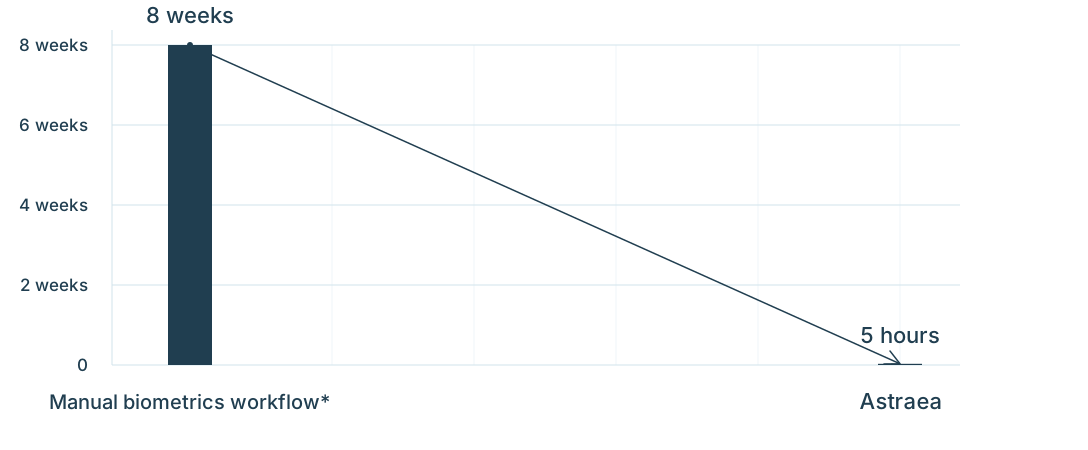
We’ve now completed our first enterprise deployments, and those initial deployments have been successful. Bringing Astraea into real working environments has helped us understand how teams investigate results, handle incomplete specifications, and decide whether an output is ready to accept. That experience is helping us build Astraea around how biometrics teams actually work, from investigating a discrepancy to reviewing the final output.
Next, we’re extending Astraea across more of the clinical biometrics workflow, with deeper execution, validation, and coordination between tasks. We’re also expanding evaluation to measure repeatability, errors, human intervention, and the time and cost required to reach an accepted result. As more teams use the platform, their experience will guide which workflows we support next and how we improve review. Our aim is to give scientific teams more time for study design, interpretation, and the questions their trials are meant to answer. We’re working toward a future where scientific teams can take on the most ambitious analyses without spending more time managing the work behind them.